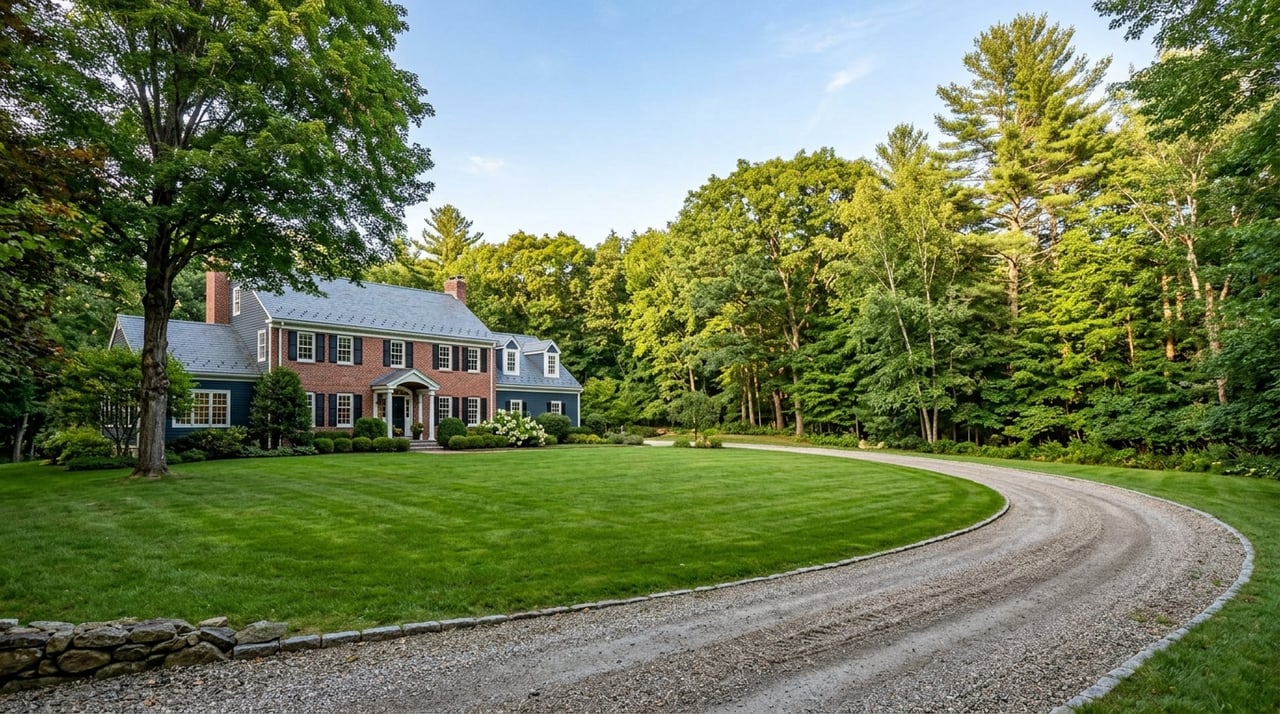
Ready for more elbow room in Brookline? Buying land or a larger lot can open the door to the kind of space many buyers want, but in this market, acreage alone does not tell the whole story. If you are thinking about building, expanding your options, or simply buying more land with your next home, this guide will help you understand what really matters in Brookline before you commit. Let’s dive in.
Why bigger looks different in Brookline
In Brookline, buying bigger often means choosing between raw land and an existing home on acreage. The town’s 2023 median purchase price for primary homes was $590,000, according to Brookline’s 2024 Master Plan. Current listing snapshots also show how varied the options can be, from land listings around 1.22 to 1.24 acres priced at $275,000 to $300,000, to improved homes ranging from $475,000 on 2.05 acres to $925,000 on 2.38 acres.
That comparison can make land seem like a shortcut to space. But the real question is not just how many acres a parcel has. The key question is whether that parcel can legally and practically function as a buildable lot.
Buildable land matters most
A parcel in Brookline may look promising online and still require deeper review. Zoning, frontage, wetlands, floodplain, and septic and well feasibility can all affect whether you can build the home you have in mind. That is especially important in a town where land inventory is thin and smaller parcels can attract attention quickly.
If you are shopping for land, think beyond the listing photos and lot size. You want to know what part of the site is actually usable under local rules. That is the difference between owning acreage on paper and owning a lot that supports your plans.
Brookline lot standards to know
Brookline’s zoning ordinance uses two base districts: Industrial-Commercial and Residential-Agricultural. For many buyers focused on homesites and larger lots, the Residential-Agricultural District is the one that shapes the conversation. The town also applies overlay districts, including Wetlands Conservation and Aquifer Protection, which can further affect how land is used.
Default residential lot size
In the Residential-Agricultural District, the default standard is 88,000 contiguous square feet of land, excluding wetlands, water bodies, and the 100-year floodplain, plus 200 feet of frontage. That lot size is about 2.02 acres. The ordinance also states that only one dwelling unit is permitted per building lot, subject to accessory dwelling unit rules.
This is why a 1.2-acre listing should never be assumed buildable under the standard conventional rules. If a parcel is under about 2 acres, you need to find out whether it qualifies under another path.
Back lot rules
Brookline allows back lots, but the standards are stricter than many buyers expect. A back lot must have at least 5 acres of total lot area, 88,000 contiguous square feet of buildable area, 30 feet of frontage, and a 100-foot minimum setback from an existing public road.
If you are drawn to privacy and want a home tucked off the road, this matters. A parcel that looks secluded may still need to meet very specific access and dimensional requirements.
Open-space development option
Brookline also has an open-space development option in the Residential-Agricultural District. Under that framework, a tract must be at least 20 acres, and at least 35% of the tract must remain permanent open space. Lots may then be as small as 44,000 square feet with 80 feet of frontage, while the overall density remains one unit per 88,000 square feet.
For buyers, this means a smaller lot size does not always mean a parcel is non-buildable. It may be part of an approved open-space plan with a different set of standards.
Pre-zoning nonconforming lots
Brookline’s ordinance also allows certain pre-zoning nonconforming lots of record in the Residential-Agricultural District to support a single-family dwelling. To qualify, the lot must have at least 44,000 square feet and 150 feet of frontage on a Class V road or better, and required setbacks still need to be met.
This is another reason careful review matters. A smaller lot may work, but only if it fits the town’s specific criteria.
Why acreage can be misleading
When you see a lot advertised by total acreage, it is easy to picture all of that land as usable. In Brookline, the ordinance makes clear that wetlands, water bodies, and floodplain do not count toward the default contiguous lot area standard. So a parcel that says 2.5 acres on paper may have less buildable area than you expect.
That is where due diligence becomes essential. In many cases, you may need a surveyor or wetland professional to confirm what is really buildable before you move too far ahead.
Wells and septic can shape your plans
In Brookline, site feasibility often comes down to water and wastewater, not just acreage. New Hampshire Department of Environmental Services says about 46% of residents statewide use private wells, and about 65% of housing units rely on septic systems. That makes private-site systems a normal part of the conversation when you buy land here.
Well setbacks matter
NHDES guidance says a well must generally be:
- 50 feet from surface water bodies
- 75 feet from property lines
- 75 feet from potential contamination sources
- At least 75 feet from septic-system components on lots with septic design flows up to 750 gallons per day
If a property cannot meet those setback rules, installing a well may be prohibited or may require a setback reduction process. That can be a major issue on smaller or irregularly shaped lots.
Septic layout matters too
For a new lot, the well location should be coordinated with the septic designer before the design is finalized. The drilled well is also expected to match the approved location. In other words, your build plan needs to work as a system, not as separate pieces.
If a property is served by septic and sits within 200 feet of a great pond or a fourth-order-or-higher river, NHDES says a site assessment is required before transfer. That is a good example of how location on the lot can affect process and timing.
Subdivision rules can affect cost and timing
If you are buying a larger parcel with plans to split it later, Brookline’s subdivision regulations deserve close attention. The town says lots created through subdivision must provide adequate capacity for sanitary sewage disposal. The rules also state that no subdivision may be sold or offered until the final plat is approved and other permits are issued.
That means future split potential should never be treated as automatic. If your decision depends on subdivision possibilities, make sure you understand the approval path, review costs, and timeline before you buy.
For subdivisions creating four or more lots, Brookline may require fire-protection water supply or cisterns if the project is not within 2,500 feet of an approved water source. Requirements like that can significantly change your development budget.
What to ask before buying land in Brookline
If you are serious about buying land or a larger lot, asking the right questions early can save time and money. Here are some of the most important ones to bring to town officials and your land-use professionals.
Questions for the town
- Which zoning district and overlays affect this parcel?
- Is this a conventional lot, back lot, open-space-development lot, or pre-zoning nonconforming lot of record?
- What is the exact buildable area after wetlands, water bodies, and floodplain are excluded?
- Does the frontage and access meet current ordinance requirements?
- If the lot is nonconforming, is the road a Class V road or better?
- If subdivision is part of the plan, what approvals, fees, and final-plat steps apply?
- Is there a recorded survey, or are you only looking at an assessor map?
Questions for your surveyor, builder, and septic designer
- Where can the well and septic field actually go on the site?
- Do the required setbacks work based on the lot’s shape and conditions?
- Has the parcel been wetland-delineated?
- Does any part of the lot fall in floodplain, wetland buffer, or aquifer overlay?
- Are driveway, culvert, grading, erosion-control, and other site costs built into the budget?
- If you want to split the land later, what consultant costs and review time should you expect?
Do not rely on tax maps alone
Brookline’s tax maps are prepared for tax assessment purposes and are explicitly not intended for conveyances. That means the map lines you see should not be treated as final boundary evidence. Before you rely on lot lines, frontage, or shape, a survey should confirm the details.
This step is especially important when frontage minimums and buildable-area calculations can make or break a parcel. A small difference on paper can have a big impact on your plans.
Is buying land in Brookline worth it?
For the right buyer, absolutely. If you want more privacy, a custom home, room for outdoor living, or a property with future flexibility, Brookline can be a compelling place to think bigger. But in this market, smart land buying is less about dreaming big and more about verifying the details that make a property usable.
That is where local guidance helps. When inventory is limited and zoning rules are specific, having a team that understands Southern New Hampshire land questions, buyer strategy, and the local transaction process can make your search much smoother.
If you are weighing land, larger lots, or homes with acreage in Brookline, Tim Morgan can help you evaluate the options, ask the right questions, and move forward with confidence.
FAQs
What lot size is typically required to build in Brookline NH?
- In Brookline’s Residential-Agricultural District, the default standard is 88,000 contiguous square feet of land, excluding wetlands, water bodies, and floodplain, plus 200 feet of frontage.
Are 1.2-acre lots buildable in Brookline NH?
- Not automatically. A 1.2-acre parcel may be buildable only if it qualifies under another approval path, such as a pre-zoning nonconforming lot or an approved open-space development standard.
What should you check before buying land in Brookline NH?
- You should confirm zoning district, overlays, frontage, buildable area, wetlands, floodplain, well and septic feasibility, and whether a survey exists.
Do Brookline NH land listings always include usable acreage?
- No. Total acreage listed online may include wetlands, water bodies, or floodplain that do not count toward the town’s default buildable lot standard.
Why are wells and septic so important for Brookline NH land?
- Many properties in New Hampshire rely on private wells and septic systems, so setbacks, soil conditions, and site layout can determine whether a parcel can support a home.
Can you use Brookline NH tax maps to confirm property boundaries?
- No. Brookline’s tax maps are for assessment purposes only, so you should use a survey to confirm boundaries and frontage before relying on map lines.