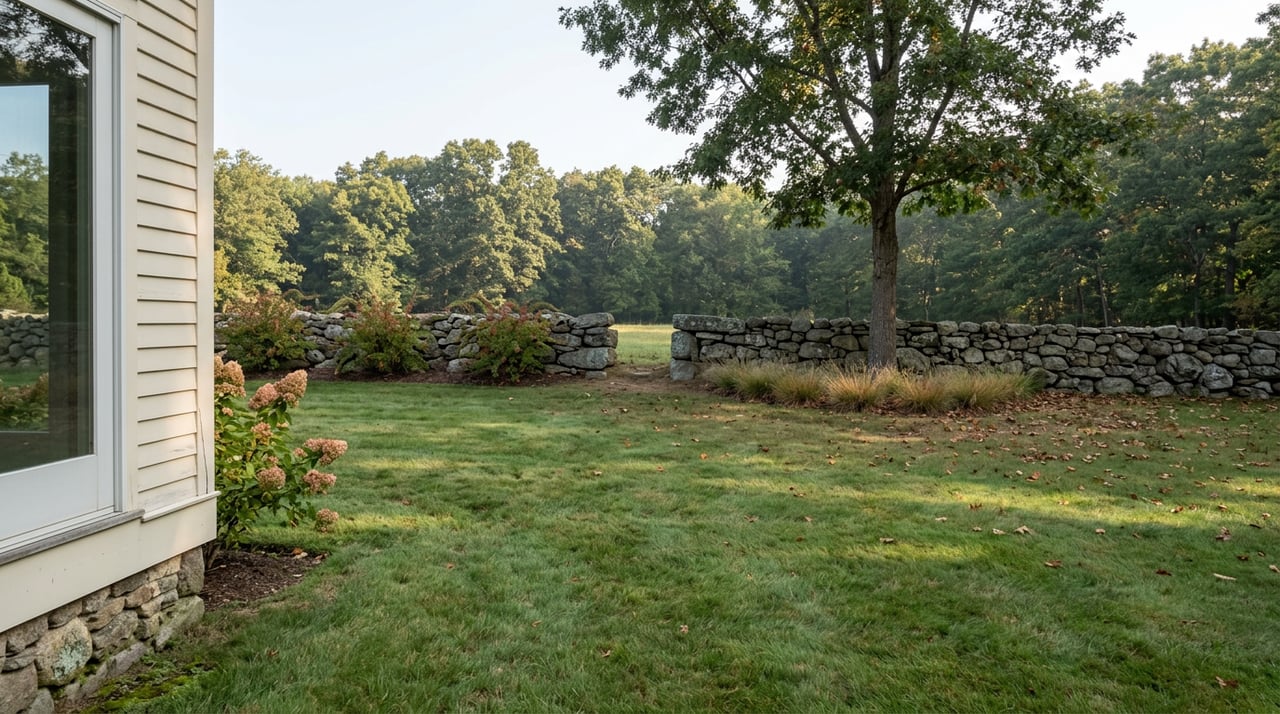
Picture two houses half a mile apart in Hudson, similar square footage, similar price range, both looking like a clean weekend showing. One of them connects to town sewer. The other flushes into a tank buried in the backyard, installed sometime before anyone thought to write down where. Nothing on the listing sheet tells you which is which. The buyer finds out during underwriting, usually later than they'd like.
That gap between what a Hudson listing shows and what a Hudson closing actually requires is the real story behind this market right now. The median price gets all the attention. The sewer district line, the one that decides whether your closing takes three weeks or six, gets almost none.
The Median Price Is Answering a Different Question Than You Think
As of mid-2026, Hudson's median listing price sits around $599,900, while homes are actually closing at a median closer to $460,000. That is not a market cooling off. It reflects a heavy volume of condo and townhouse sales moving through the mix, pulling the closing number down relative to what single-family listings are asking. If you are shopping for a detached house with a yard, that $460,000 figure is not really describing your competition. It is describing a market where a large share of what changed hands recently wasn't a single-family home at all.
This matters for a reason that has nothing to do with pricing strategy. Condos and townhouses in Hudson are almost always on municipal water and sewer. Detached single-family homes, especially the older ones on larger lots, are a mixed bag. So when the median blends both, it quietly erases the exact distinction that determines whether your closing is routine or complicated.
The Line on the Map Nobody Shows You
Hudson does not have sewer service everywhere. The town maintains a defined sewer district, and a property has to fall inside that boundary to connect at all. The map lives at the Engineering Department and the Sewer Utility office, not on any MLS sheet. A house one street over from a sewer-connected neighbor can sit just outside the line and rely entirely on a private septic system instead.
If a property is inside the district and needs to connect, Hudson charges a one-time residential hookup fee of $2,325 plus a $50 application fee, and that figure covers the connection assessment only, not the actual plumbing or excavation work to tie the house in. There is also a mechanism called a sewer betterment district, where the town can assess a specific neighborhood for infrastructure work that benefits it directly. If you are eyeing a part of Hudson where sewer lines are being extended, that is worth asking about before you fall in love with the house.
There is a piece of Hudson's sewer story that rarely comes up in a walkthrough: since 1979, Hudson has sent its sewered wastewater across the river to Nashua's treatment facility under an intermunicipal agreement between the two towns. Hudson's own water, meanwhile, comes from a mix of a community well in Litchfield and purchased supply from Pennichuck Water Works. None of this changes a buyer's monthly bill in a dramatic way, but it explains why Hudson's utility infrastructure is genuinely a shared regional system, not a self-contained one, and why a property sitting right along the Merrimack River across from Nashua can have utility arrangements that trace back decades before the current owner ever bought the place.
What Happens When Your Septic Has No Paper Trail
Here is the detail that catches buyers off guard most often. Septic design plans were not required in Hudson until 1967. If a house and its septic system were built before that year, the town simply does not have a plan on file, because none was ever mandated. New Hampshire's state septic records follow the same cutoff. Records begin in 1967 when the state's Subsurface Systems law took effect, and anything before that does not exist anywhere, not at the town, not at the state Department of Environmental Services.
For a lot of Hudson's housing stock, this is not a footnote. Older farmhouses and colonials scattered through town, the kind that show up in listings with tin ceilings and restored wood floors, are exactly the properties most likely to fall into this gap. A buyer who assumes a septic plan exists somewhere in a file cabinet is often wrong. What that means practically is that a licensed septic designer typically has to dig a test pit to determine the system's actual condition and capacity, rather than simply pulling a diagram.
The Inspection Nobody Requires, But Every Lender Wants Anyway
New Hampshire state law does not mandate a septic evaluation before a home sale. Almost no lender will approve a mortgage without one anyway. That contradiction trips up buyers who read "not required by law" and assume it means "not required." In practice, it just means the requirement comes from your bank instead of the state, and it shows up on your timeline the same way either way.
A proper real estate septic evaluation checks the tank, the distribution box, the leach field, and the baffles, and it typically comes back as a documented report within a couple of business days once scheduled. Recommended inspection frequency for an active system generally runs every one to three years, more often for heavier household use or an older system. If you are buying a Hudson home with any septic age or history uncertainty, budgeting time for this step, not just money, keeps your closing on schedule.
Geography adds another wrinkle. Hudson sits low along the Merrimack River, directly across from Nashua, and low-lying, river-adjacent lots are more likely to have a high water table or shallow bedrock close to the surface. When a standard gravity-fed septic system will not work on a site like that, the common fix is a mound system, which elevates the drain field above grade to get proper separation from groundwater. Mound systems work well, but they cost more to install and they are a different animal to inspect than a conventional system, which is one more reason the septic conversation should start early, not during the option period.
What This Means If You're Buying or Selling in Hudson Right Now
| Situation | What to check first | Why it matters |
|---|---|---|
| House built before 1967 | Ask the Community Development office if any plan exists, then budget for a test pit if not | No plan is legal, not unusual, but it changes your inspection timeline |
| House on private septic | Book a licensed evaluation early, not during your option period | Lenders require it even though the state doesn't, and scheduling takes time |
| House near the river or on a low lot | Ask directly whether the system is conventional or a mound system | Mound systems cost more and inspect differently |
| House you're told is "on sewer" | Confirm it against the town's actual sewer district map, not the listing description | Being nearby isn't the same as being inside the district |
| Selling an older Hudson home | Get ahead of the septic question before listing | A clean septic report removes the single most common financing delay |
If you are selling an older Hudson property, getting a septic evaluation done before you list, rather than waiting for a buyer's lender to force the issue, can be the difference between a smooth thirty-day close and a financing delay nobody saw coming. If you are buying, ask the septic-or-sewer question before you ask about square footage. It tells you more about your actual closing timeline than almost anything else on the sheet.
A Few Straight Answers
How do I find out if a specific Hudson address is inside the town sewer district? The sewer district map is kept at Hudson's Engineering Department and the Sewer Utility office. A call to the Sewer Utility office can confirm whether a given address falls inside the boundary before you write an offer.
Does New Hampshire require a septic inspection before closing? No. State law does not mandate one. Nearly every mortgage lender does, which functions the same way for your timeline even though the source of the requirement is different.
What if my Hudson home's septic system predates 1967 and there's no record anywhere? That is expected, not a red flag on its own. Plans were not required before that year, and neither the town nor the state has records from that era. A licensed septic designer can evaluate the system directly, usually starting with a test pit, to determine its actual condition.
Hudson rewards buyers and sellers who ask the right question early. If you are trying to figure out what a specific Hudson property will actually cost to close, not just to list, the Morgan Moves Team can walk you through the sewer district map, the septic history, and everything in between before you're staring down a financing deadline. Request Your Free Home Valuation and let's get ahead of it together.