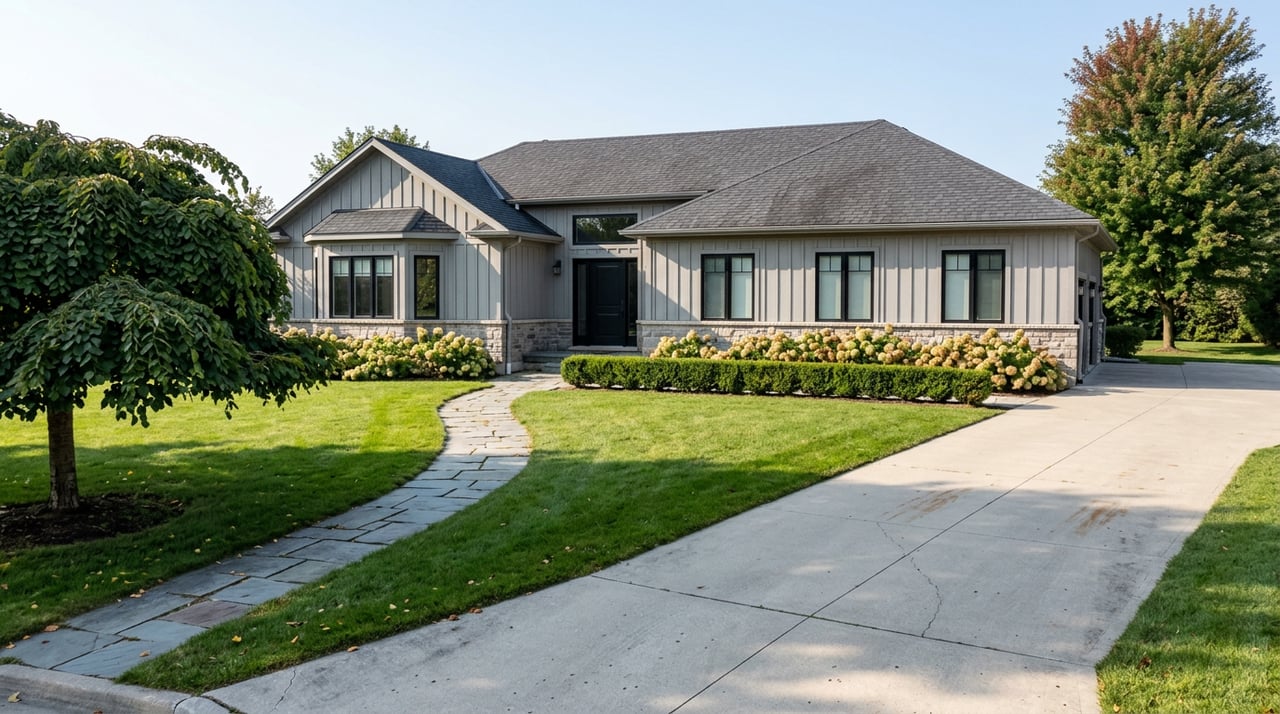
In July 2026, a two-bedroom house on Mack Street in Bedford sold for $420,000 after three days on the market. That same month, a five-bedroom home on an acre and a half, roughly 4,400 square feet, sold for $1.915 million after five days on the market. Thirty-five transactions closed in Bedford that month. Five of them cleared $1.5 million. Ten cleared $1 million. A condo on Hawthorne Drive went for $482,000. A townhouse on Evening Star Lane went for $430,000.
Every one of those homes sold inside a single work week. None of them look anything like the town's median.
That is the problem with treating Bedford's median sale price, roughly $889,000 as of April 2026 according to market tracking, as a single fact about the town. A median is the midpoint of a distribution, and Bedford's distribution isn't a cluster around one number. It's two separate markets that happen to share a zip code, and the gap between them is wider than most buyers expect when they start comparing towns in southern New Hampshire.
One Number, Two Markets
Look at what actually sold in February 2026. Eleven properties changed hands that month. The most expensive was new construction on Tirrell Hill Road, which sold for $1.1 million. The least expensive was a condo on Suffolk Court, which sold for $345,000. Ten of the eleven sales were single-family homes, and two of those cleared seven figures.
Run the same comparison against July and the pattern holds. The bottom of the market that month was a starter-sized single-family home under 1,000 square feet. The top was new construction on real acreage. Everything in between, the condos, the townhouses, the older colonials, filled out a curve that a single median number was never built to describe.
This matters for anyone using an aggregate town figure to decide whether Bedford fits a budget. An $889,000 median doesn't mean most homes sell near $889,000. It means the middle observation in a sorted list happens to land there while the actual sales cluster in two places on either side of it: an entry and mid tier that behaves like a normal, competitive suburban market, and an upper tier of new construction and larger lots that behaves like its own separate category. Comparing your budget to the town median tells you almost nothing about which of those two markets you're actually shopping in.
Why Everything Moves Fast, But Not for the Same Reason
Here's the part that surprises people. The Tirrell Hill Road new construction that topped February's sales sat on the market for just under six months before it closed. The Mack Street starter that anchored July's low end was gone in three days.
That's the opposite of what most buyers assume. The instinct is to think expensive, custom-built homes sell themselves and starter homes are the ones that linger while buyers save up or negotiate. In Bedford's actual sales record, it ran the other direction. The entry and mid-tier segment, the segment where a $420,000 to $500,000 budget puts a buyer in real competition with other offers, is where the speed lives. The top of the market, where a buyer is choosing among a handful of comparable new builds rather than competing for scarce inventory, can afford to wait for the right offer.
Town-wide, the average days on market in Bedford was 13 in April 2026, up slightly from 11 the year before. That single-digit shift sounds minor until you realize it's an average smoothing over a market where a $420,000 home can move in three days and a $1.1 million new build can sit for five months. The town isn't getting slower. The mix of what's selling is just wide enough that the average barely describes either end of it.
What's Feeding the Entry-Level Squeeze
Part of why the lower and middle tiers move so fast is supply, and the supply picture in New Hampshire shifted in a way that's still working its way into local inventory. Under House Bill 577, which took effect July 1, 2025, any property owner in a zone that permits single-family homes can now add one attached or detached accessory dwelling unit by right, meaning a standard building permit is enough. No conditional use permit. No special exception hearing.
That single change matters for a town like Bedford because it widens what counts as available housing without requiring a single new subdivision. A homeowner who might have sold a starter property outright now has the option to add a unit and hold, or to sell a property with an ADU already in place as a two-income asset. Statewide, the median single-family home price hit a record $535,000 in 2025, a 3.9 percent increase over 2024, according to the New Hampshire Association of Realtors, while the state's affordability index sat at just 58, meaning the median household income covered only 58 percent of what was needed to qualify for the median-priced home. Against that backdrop, anything that adds usable housing stock without new land, like an ADU built under HB 577, is a meaningful lever even if its effects show up slowly.
None of this touches the upper tier of Bedford's market, where new construction on larger lots competes on design and finish rather than square footage per dollar. That's a separate buyer pool with a separate set of pressures, and it's part of why a single town-wide median can't carry the weight buyers put on it.
What Actually Sold, Side by Side
| Month | Low End of Sales | High End of Sales | Days on Market |
|---|---|---|---|
| February 2026 | Condo, Suffolk Court, $345,000 | New construction, Tirrell Hill Road, $1.1M | Roughly 6 months (top sale) |
| July 2026 | Single-family, Mack Street, $420,000 | New construction, 5BR/1.5 acres, $1.915M | 3 to 5 days (both ends) |
The table isn't a forecast. It's two snapshots three months apart, and the spread holds in both of them. That consistency is the actual signal. A single outlier month could be explained away. Two months with the same shape suggests the shape is the market, not a fluke.
What This Means If You're Comparing Bedford to Other Towns
If you're weighing Bedford against Merrimack, Hollis, or another Southern New Hampshire town on the strength of a median price alone, you're comparing an incomplete number to other incomplete numbers. The more useful question isn't "what's Bedford's median" but "what actually closed in the price band and property type I'm targeting, in the last one or two months." A $450,000 budget in Bedford is shopping the fast-moving, competitive end of the market where days-on-market numbers in the single digits are normal. A $1.2 million budget is shopping a smaller pool of new construction and larger-lot properties where patience, not speed, tends to win.
Sellers should take the same lesson in the other direction. A home that fits the entry or mid-tier profile, smaller lot, existing construction, walkable or near-walkable to town amenities, is competing in the segment where Bedford's fastest sales happen. A home that looks more like the Tirrell Hill Road listing, new construction on a larger lot, is competing in a smaller field where pricing and presentation carry more weight because there's no crowd of buyers forcing a quick decision.
A Few Straight Answers
Is Bedford, NH a buyer's market or a seller's market right now? It depends on which Bedford you mean. The entry and mid-tier segment behaves like a seller's market, with homes moving in days. The upper tier, new construction and larger-lot properties, gives buyers more room to negotiate and more time to decide.
Why did the priciest home in February take six months to sell while a much cheaper home in July sold in three days? Fewer buyers compete for new construction on larger lots, so those listings can sit until the right buyer appears. More buyers compete for entry and mid-tier resale homes, so those listings move fast even though the price is lower.
Does the new accessory dwelling unit law apply to homeowners in Bedford? Yes. House Bill 577 is a statewide New Hampshire law, effective July 1, 2025, and it applies to any property in a zone that already permits single-family homes.
If you're trying to figure out which segment of Bedford's market actually matches your budget and timeline, that's a conversation worth having with someone who tracks these closings month to month rather than glancing at a single town-wide average. The Morgan Moves Team can walk you through what's actually closing in your price range right now. Request Your Free Home Valuation to start.